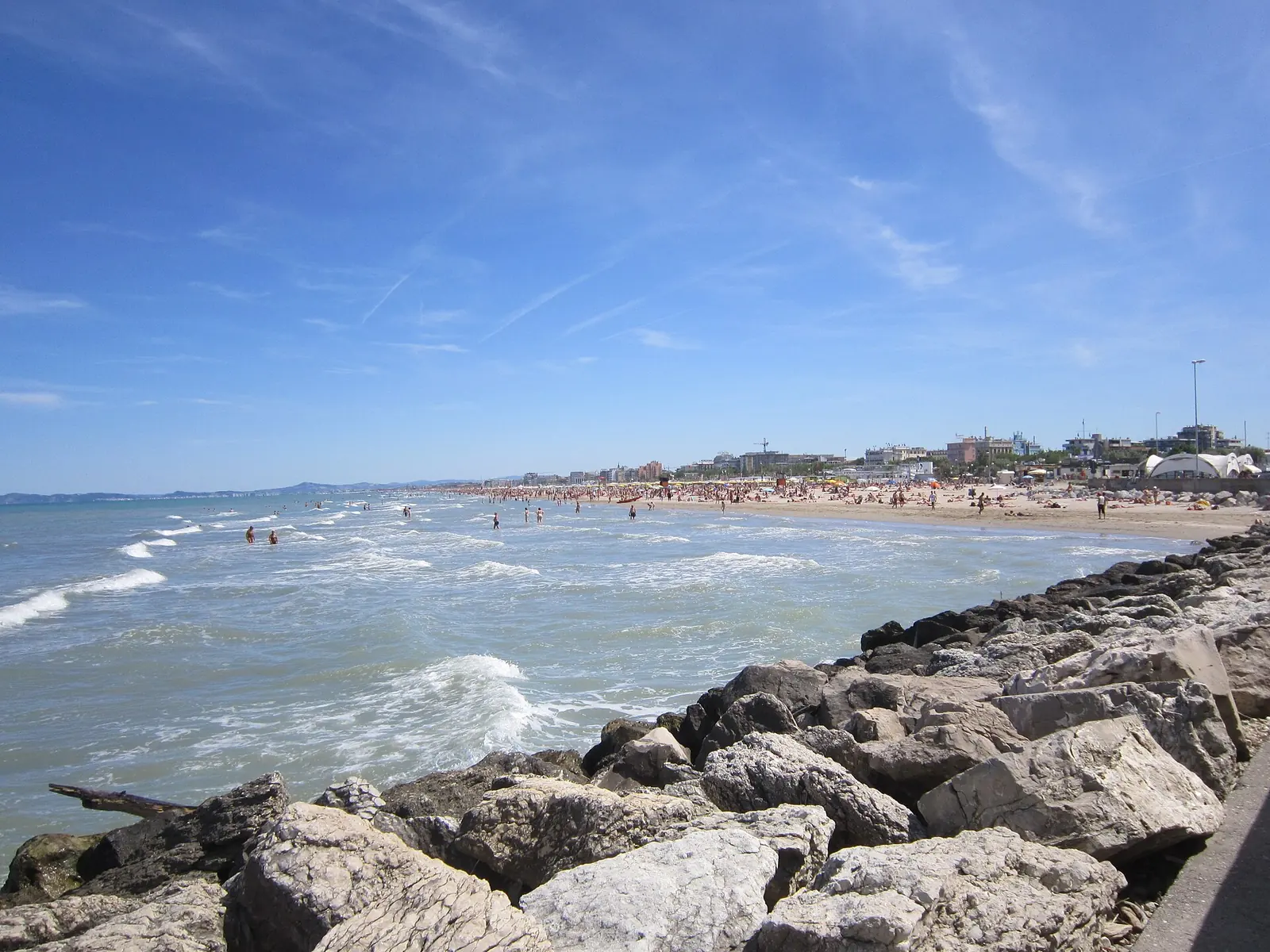
From Milano Marittima to Gabicce Mare, the Riviera Romagnola is a low-lying coast of fine sand, interrupted by canal harbours and river mouths and ending in the San Bartolo headland to the south. All nine resorts received the Blue Flag in 2026. Beach width, sea defences and water classification vary from one to another.
A low-lying coast protected from the sea
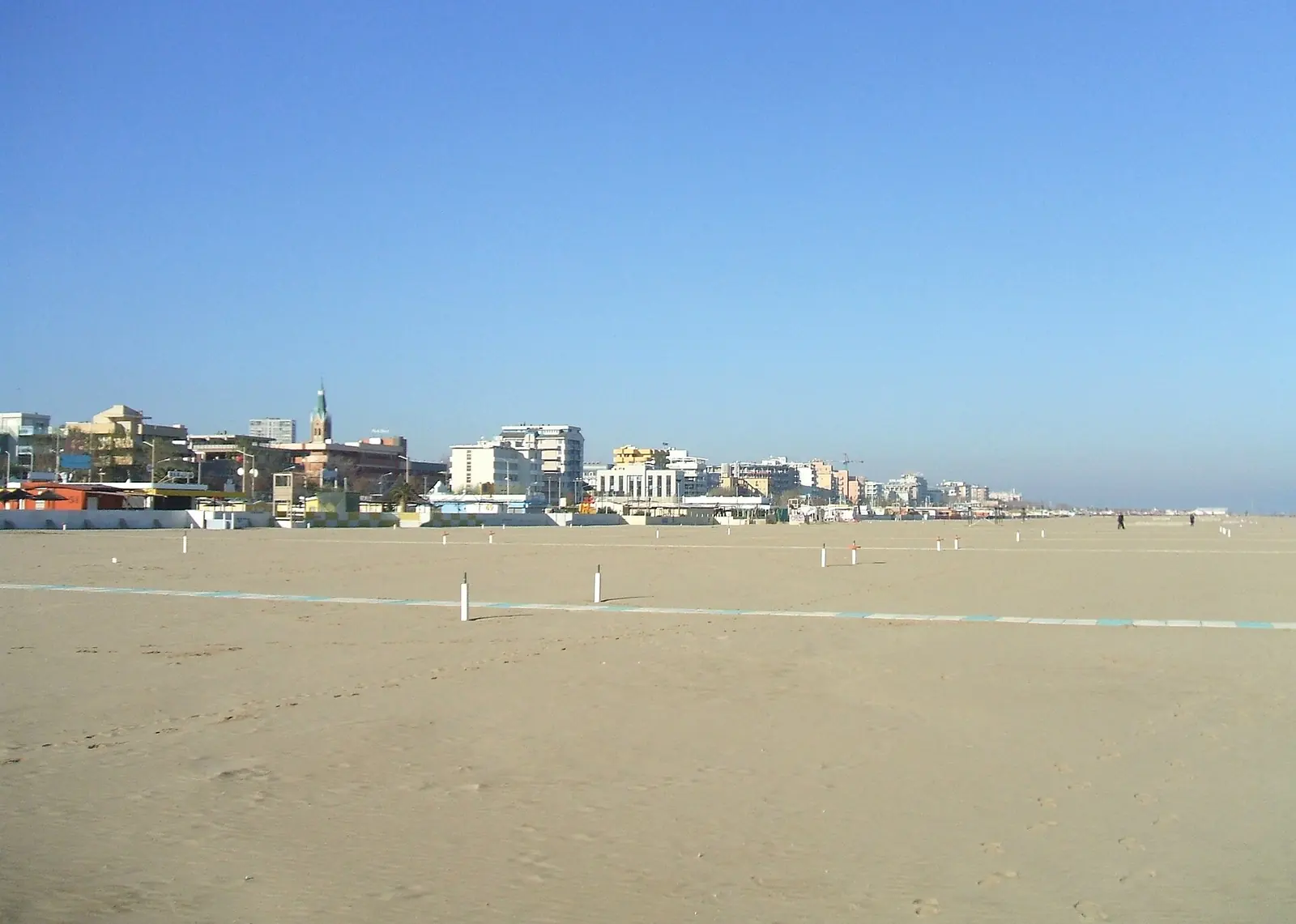
According to Arpae and the Regione's report on the state of the coast, Emilia-Romagna's coastline is a low-lying sandy beach extending 110 kilometres from the Tavollo mouth in Cattolica to the Po di Volano mouth, plus about ten kilometres facing Sacca di Goro. Between the beach and the first metre of water, 86% of samples taken consist of fine sand. In 2018, beaches ranged from 40-60 metres wide to over 180, with the widest beside Rimini pier and Cervia harbour, where sea-borne sand accumulates. Gabicce Mare, the ninth resort, is already in the Marche.
Coastal defences and beach nourishment alter the coastline's shape. The 20 kilometres between Rimini and Cesenatico piers are entirely protected by stone structures, mainly breakwaters parallel to the shore; Cattolica has seventeen, and in Misano Adriatico a series of groynes divides the sea into basins. Between Riccione harbour and Rimini pier, however, the 2018 coastal report describes 11 kilometres without emerged defence structures. In 2002, 2007, 2016 and 2022, the Regione brought large quantities of sand dredged offshore to the coast; according to the Regione, this nourishment explains why only 18% of the coastline was eroding in 2018.
The nine beaches compared
Each Comune measures its coast using its own criteria; for Bellaria Igea Marina and Riccione, the length comes from the regional coastal report.
| Resorts | Length | Useful information |
|---|---|---|
| Milano Marittima beach | 3.7 km (Comune di Cervia) | beach establishments 235 to 340, three natural dunes, erosion to the north |
| Cervia, Pinarella and Tagliata beach | 5.3 km (Comune di Cervia) | growing beach, pinewood between the sand and houses in Pinarella and Tagliata |
| Cesenatico beach | about 7 km (Comune) | five areas on either side of the canal harbour, breakwaters south of the harbour |
| Bellaria Igea Marina beach | about 6.7 km (Regione) | parallel breakwaters, Igea Marina seafront refurbished in 2026 |
| Rimini beach | about 15 km (Comune) | breakwaters to the north; a wide beach to the south, without the northern coast's row of emerged breakwaters; two numbering systems for beach establishments |
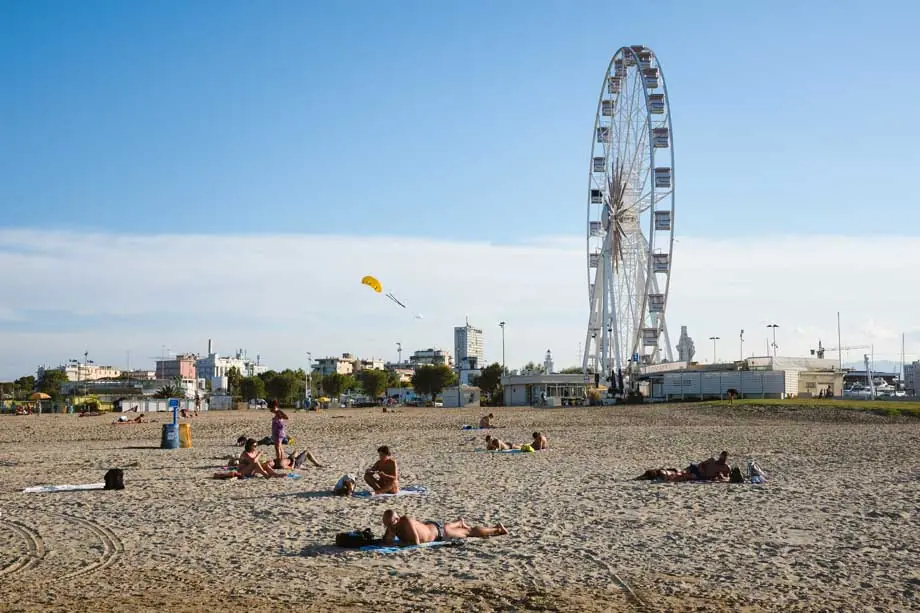
| Riccione beach | 6.2 km (Regione) | no emerged breakwaters, beach establishments numbered from the south, the Riccione beach tent |
| Misano Adriatico beach | about 3 km (Comune) | sand spits to the north, basins between groynes to the south |
| Cattolica beach | 2,185 m of seafront (Comune) | Levante and Ponente separated by the jetty, seventeen breakwaters |
| Gabicce Mare beach | not stated | gently sloping seabed, followed by the San Bartolo cliffs |
How a beach establishment works
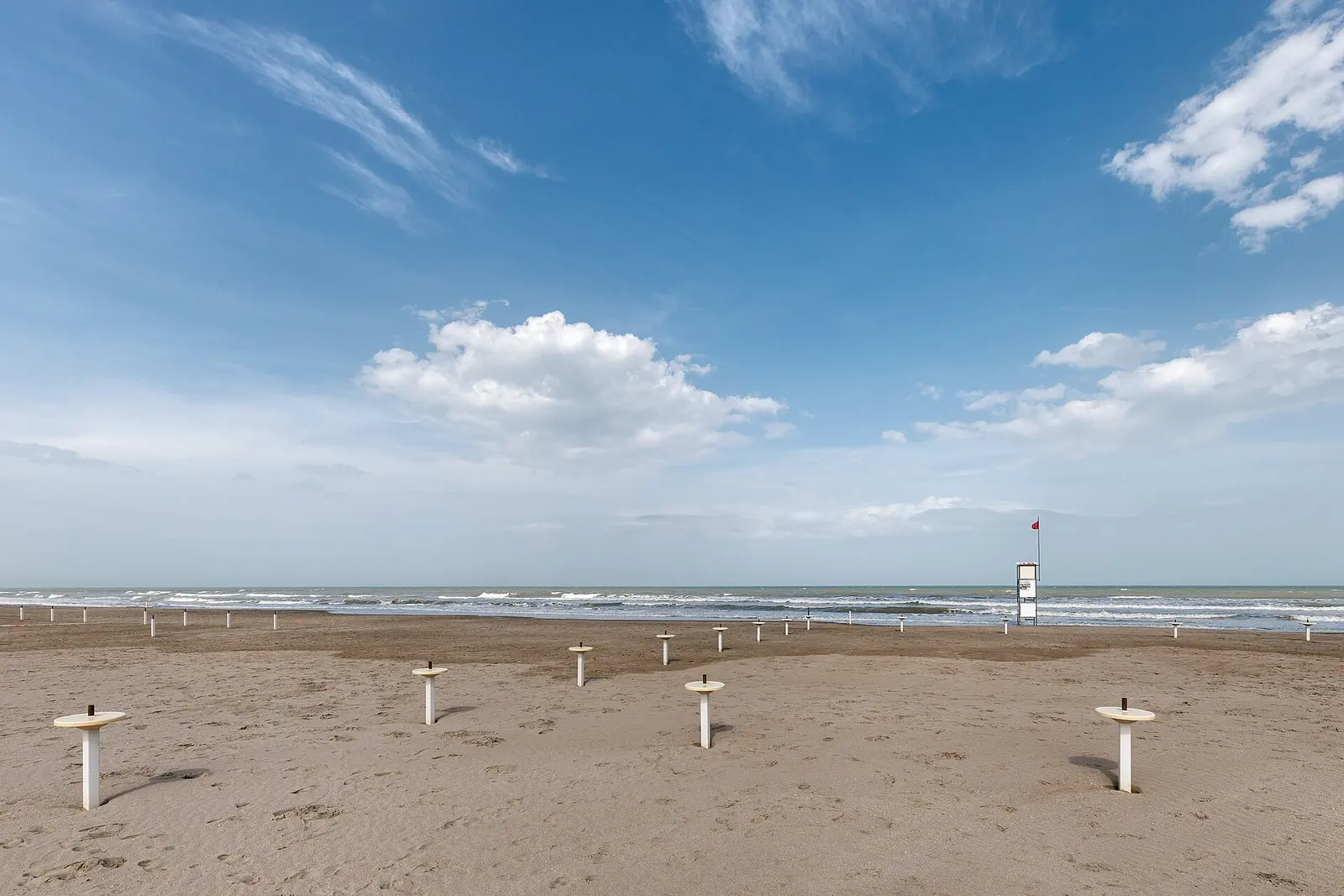
Almost the entire coast is organised into beach establishments, known as bagni, and in Emilia-Romagna the Regione ordinance sets the basic rules. During the lifeguard period, set by the ordinance from the third weekend in May to the third in September (16 May to 20 September in 2026), establishments must remain open at least from 9.30am to 6.30pm, provide free toilets for anyone on the beach and have walkways and routes to the shore for people with disabilities. Each parasol must have at least 12 square metres, but Comuni can change the measurement: Rimini requires 15, while Bellaria Igea Marina allows 10.50 because of erosion. Every establishment must have its number painted on the roof or cabins so the air ambulance can find it.
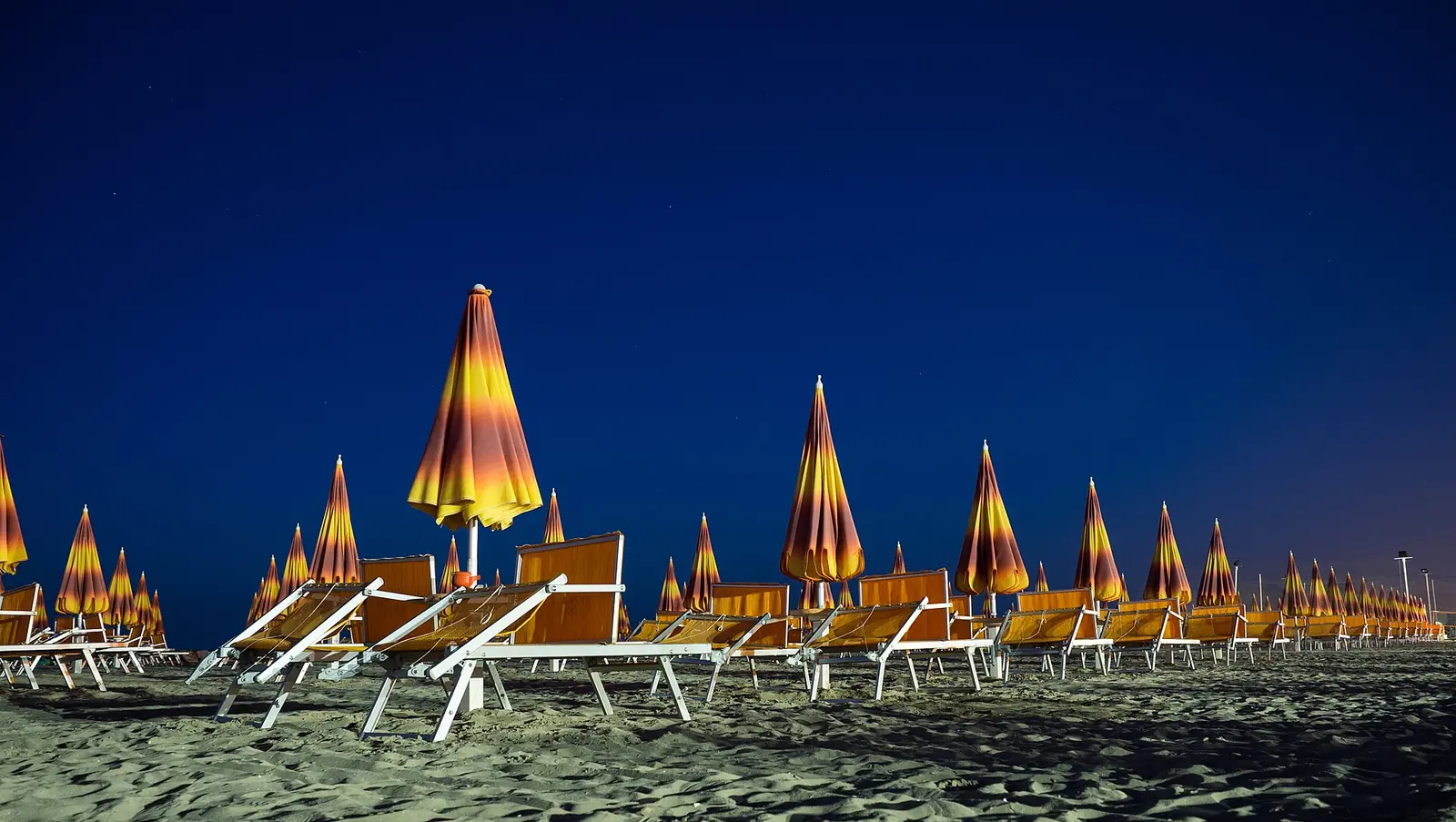
Numbering varies between Comuni. Rimini has two systems, one north and one south of the canal harbour; in Riccione, numbers start in the south at the Misano boundary; in Cervia, a single series runs from Tagliata to Milano Marittima; in Cesenatico, ordinances identify beach establishments by name. In Riccione, the Comune declares all 130 establishments accessible, and many still erect the beach tent, a structure of poles, crosspieces and canvas listed by Ministero della Cultura among local traditional heritage assets.
Where the sand ends
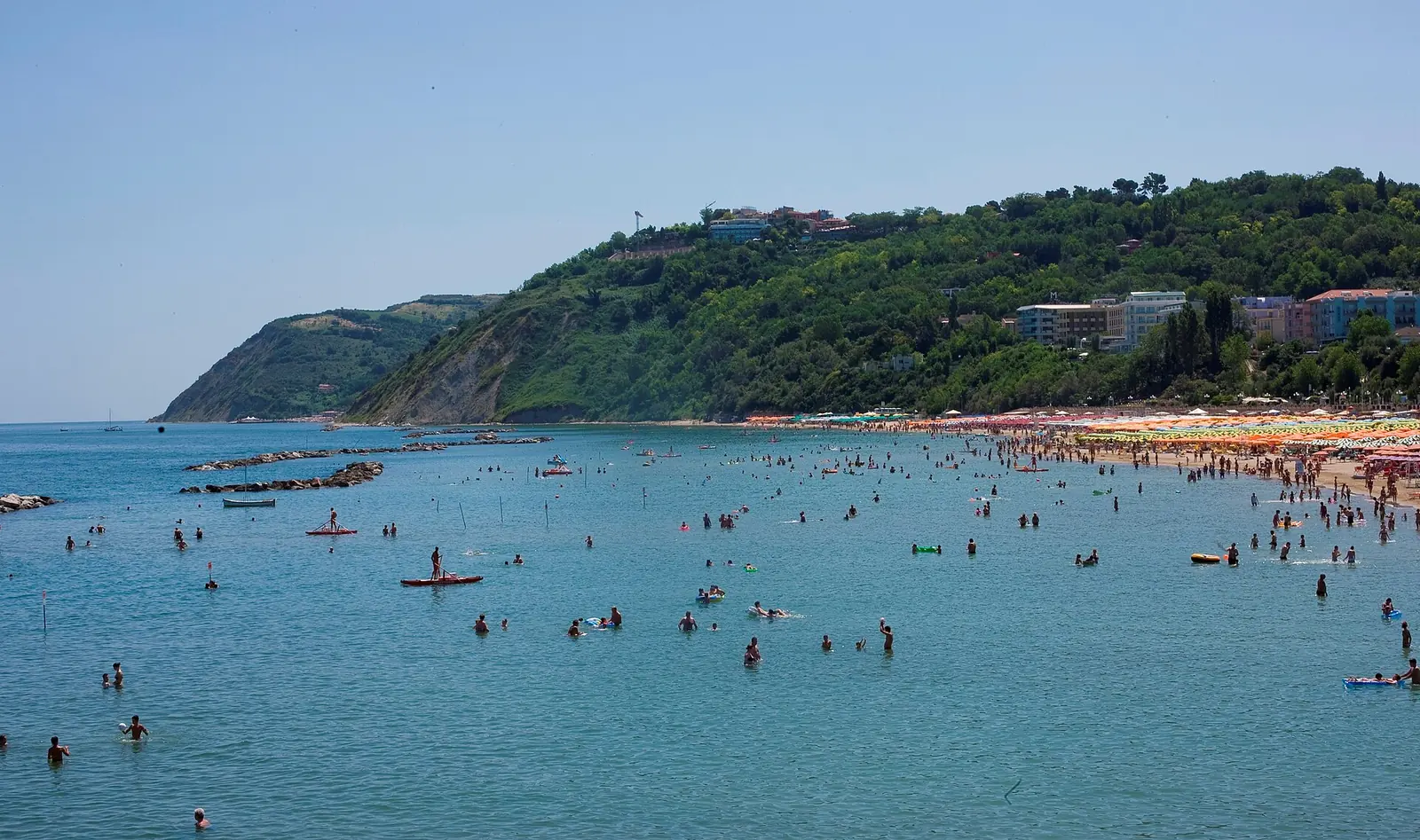
Gabicce Mare is the only one of the nine resorts where the beach ends against a headland. As far as Sottomonte, the sand is fine and the seabed slopes gently, sheltered by breakwaters; towards Sottomonte, the first pebbles appear, then Gabicce Monte hill reaches the shore and the Monte San Bartolo cliffs begin, with beach stretches subject to access bans because of the cliffs. Vallugola bay, already within the natural park, is under concession to a beach establishment. Further south, in the Comune di Pesaro, below the village of Fiorenzuola di Focara, a small free beach is reached on foot.
Free beaches
Free beach stretches remain between establishments in all nine resorts, and each Comune identifies them in its own list or ordinances. Sizes and facilities vary: some stretches have equipment, while others are simple gaps between establishments.
| Resorts | Free beaches | Useful information |
|---|---|---|
| Free beaches in Milano Marittima | one, on Viale Forlì | toilets and showers; the dune opposite the former Colonia Varese is protected |
| Free beaches in Cervia and Pinarella | Lungomare Grazia Deledda in Cervia; beach establishment 102 in Pinarella | no free stretch listed in Tagliata |
| Free beaches in Cesenatico | stretches between Zadina and Villamarina, without an official list | Tamerici and Zona Cesarini with services; stretches open to dogs |
| Free beaches in Bellaria Igea Marina | Parco Pavese, canal harbour and small stretches in the former holiday colony area | Comune services and lifeguards at Parco Pavese |
| Free beaches in Rimini | one equipped area at Piazzale Boscovich and about fifteen stretches between beach establishments | Spiaggia Libera Tutti, designed for people with disabilities |
| Free beaches in Riccione | thirteen according to the Comune portal | five open to dogs in the early morning and evening |
| Free beaches in Misano Adriatico | three, under concession to the Comune, totalling 99 metres | services at Parco Mare Nord |
| Free beaches in Cattolica | five stretches with lifeguards, from the harbour to Parco Le Navi | at Parco Le Navi, dogs only for swimming |
| Free beaches in Gabicce Mare | three: Porto, Sottomonte and Fortino | Marche rules and flags |
The basic rules are the same on free beaches throughout Emilia-Romagna. Lifeguards are compulsory for the same period as at beach establishments, from 9.30am to 6.30pm; parasols and equipment cannot remain on the sand after sunset, camping and fires are prohibited, and beach establishment toilets are also open to free beach users.
For animals, the summer season matters: the regional ordinance sets it from the Saturday before Easter to 2 November (from 4 April in 2026). During those months, animals cannot stay on the beach, with exceptions for rescue dogs, guide dogs and dogs accompanying people with disabilities, and designated areas opened by beach establishments following notification to the Comune. Outside that period, the regional ban does not apply and Comune regulations govern. From 3 November to the Saturday before Easter, for example, dogs can go on Rimini beaches on a lead or muzzled; in Cervia and Milano Marittima, at any time, on a lead and muzzled; and in Riccione, municipal regulations for the “Mare d'Inverno” season apply until 27 March 2027. Each Comune's rule is on its beach page. Gabicce Mare, in the Marche, follows the rules of its Regione and of the Capitaneria di porto di Pesaro: regional regulations exclude dogs from beaches from 1 April to 30 September, while Parco del Monte San Bartolo regulations prohibit them on park beaches in every month. In 2026, Gabicce Mare had lifeguards on free beaches from 1 July to 7 September.
The sea
Each bathing water's classification is calculated from the last four years' monitoring. For 2026, Arpae and, for Gabicce Mare, ARPAM assigned these classifications.
| Resorts | Bathing waters in 2026 |
|---|---|
| Milano Marittima and Cervia | five, all excellent |
| Cesenatico | ten: seven excellent, one good, two new and not yet classified |
| Bellaria Igea Marina | five: two excellent, covering almost the entire coast, and three good |
| Rimini | seventeen: fourteen excellent and three good |
| Riccione | eight, all excellent |
| Misano Adriatico | four, all excellent |
| Cattolica | five: one excellent and four good |
| Gabicce Mare | six monitoring points, all excellent |
In 2026, the Blue Flag went to eleven Emilia-Romagna municipalities, including the seven on the Riviera Romagnola, and Rimini regained it after fifteen years; Milano Marittima is included in Cervia's. In Marche, Gabicce Mare was among twenty awarded municipalities, for the thirty-third time. FEE, an international organisation, awards it annually, assessing water quality, environmental management, safety, accessibility and services.
Behind the sand
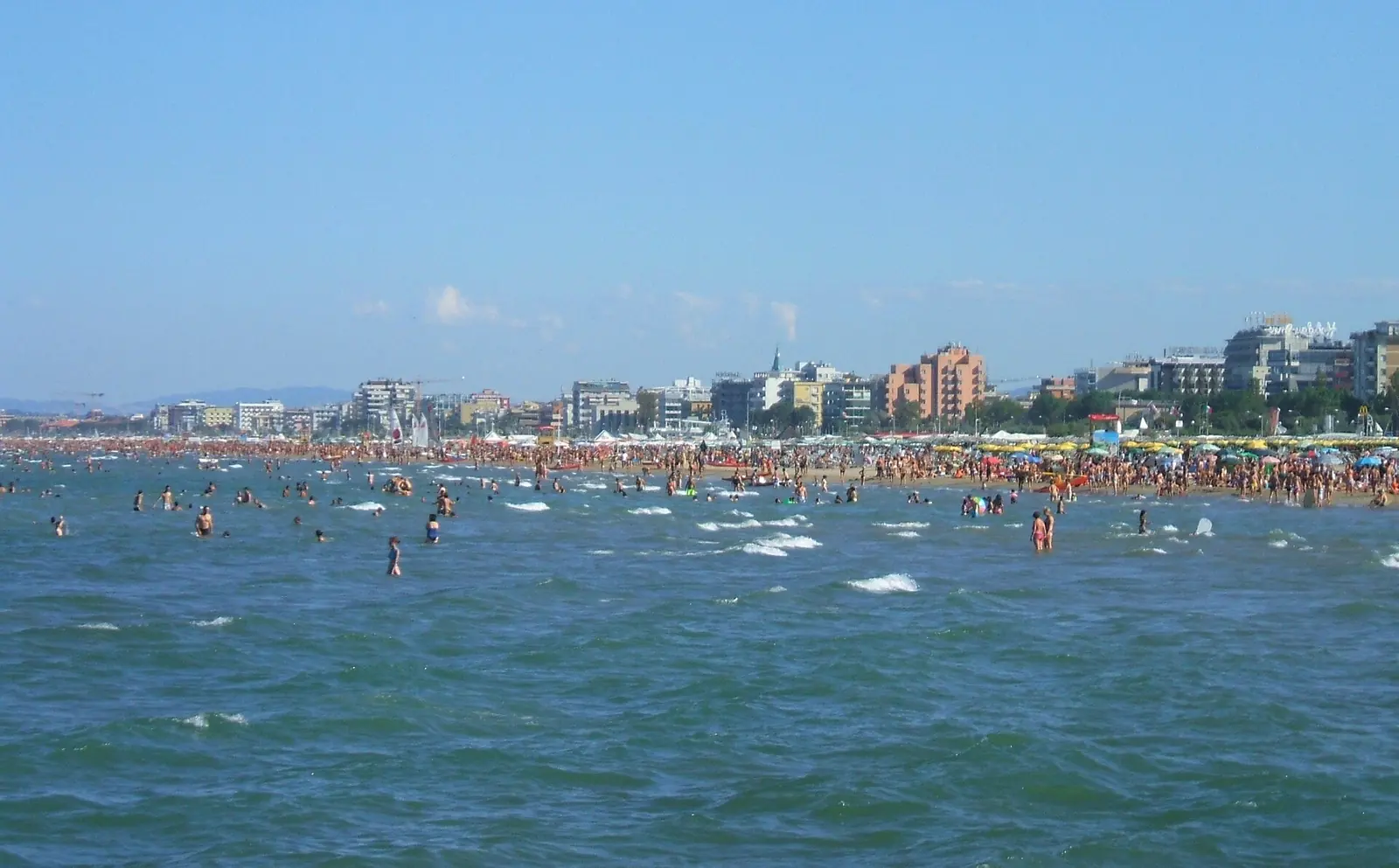
In recent years, the most visible changes have taken place behind the beach. In Rimini, the old seafront is becoming Parco del Mare, with greenery and shared cycle and pedestrian routes: the northern stretch, from Rivabella to Torre Pedrera, has been complete since 2021; in the south, part is ready and funding is still lacking for three more stretches. In Igea Marina, one kilometre of seafront was refurbished in 2026, and in Misano Adriatico the southern seafront in 2024; in Riccione, Lungomare del Sole towards Misano is under construction, with the Comune expecting completion in spring 2027.
In some resorts, greenery reaches almost onto the sand. Between the beach and houses of Pinarella and Tagliata lies a 24-hectare pinewood, a state nature reserve since 1977; in Zadina, at Cesenatico's northern end, a wood of about 5 hectares with pedunculate oaks, holm oaks, elms and alders adjoins the beach; in Misano Adriatico, the Parco Mare Nord pinewood is, according to the Comune, the only dense area of maritime pines on the coast of the Provincia di Rimini. Three natural dunes remain in Milano Marittima, one opposite the former Colonia Varese.
Comuni publish temporary swimming bans, and sample results are updated by Arpae for Emilia-Romagna and ARPAM for Marche. In the water, flags and lifeguard instructions apply.
Sources: Arpae and Regione Emilia-Romagna, Stato del litorale emiliano-romagnolo al 2018, and regional coastal erosion pages; Regione Emilia-Romagna, regional bathing ordinance, consolidated text with determinazione 8398 of 29 April 2026, DGR 561/2026 on bathing waters and Blue Flag press release of 14 May 2026; Ministero della Salute, Portale Acque; beach plans and ordinances of the eight Comuni; Comune di Gabicce Mare. Accessed on 29 September 2026; regional ordinance and press release rechecked on 10 October 2026.